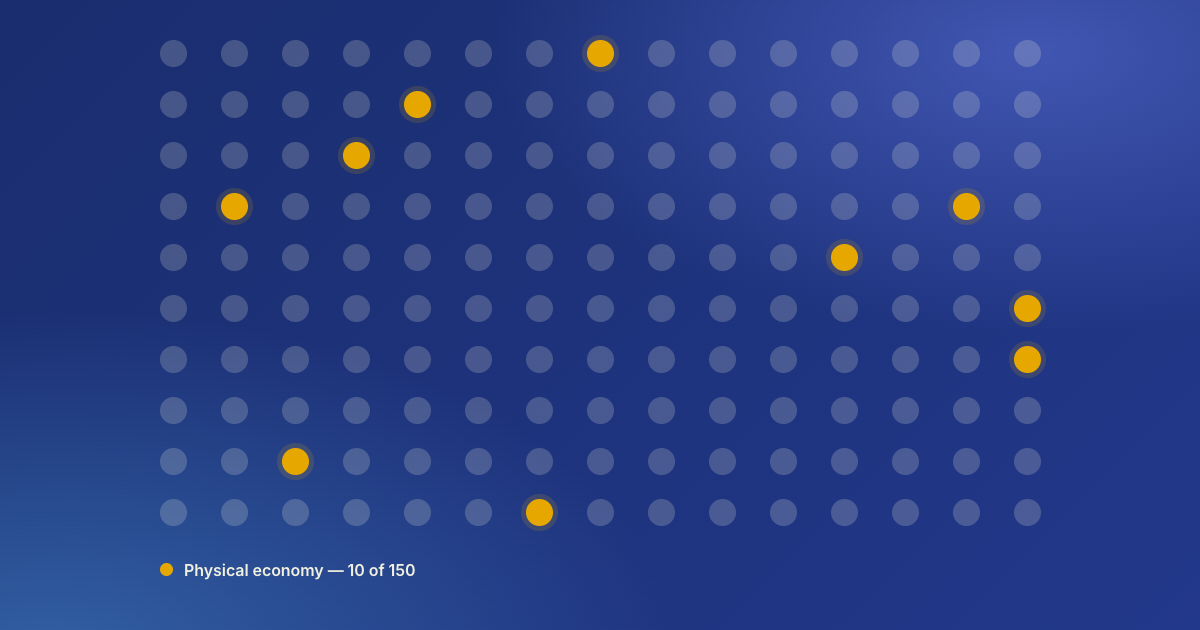
LinkedIn has named 150 US Top Voices so far in 2026 — 97 in May, and another class in August. Only ten of them come from the sectors that make up roughly a third of the S&P 500's value.
That ratio piqued our interest, so we dug into the picks to see what's going on.
A third of the market's value, one in fifteen of the voices
We classified every honoree by role, industry, and follower count, along with the location and topic tag LinkedIn published for each, and the single post its editors chose to showcase. The physical economy spans industrials, energy, utilities, consumer staples and discretionary, materials, and real estate. Its ten honorees: five from industrials, four from consumer and retail, and Southern Company's CEO, the lone energy voice on the list. We found none from materials, real estate, logistics, hospitality, or quick-service restaurants. In LinkedIn's own topic tags for the full list, "Energy and utilities" appears once.
Here is the full picture, sector by sector, with each group's share of honorees against its share of the index:
| Sector | Share of 2026 honorees | Share of S&P 500 value | Ratio |
|---|---|---|---|
| Media & entertainment | 15.3% | 9.2%* | 1.7x |
| Finance & economics | 13.3% | 12.0% | 1.1x |
| Healthcare | 7.3% | 8.7% | 0.8x |
| Technology & AI | 22.0% | 37.3% | 0.6x |
| Industrials & manufacturing | 3.3% | 9.0% | 0.4x |
| Consumer & retail | 2.7% | 15.6% | 0.2x |
| Energy & utilities | 0.7% | 5.3% | 0.1x |
| Materials & real estate | 0.0% | 2.5% | 0x |
*Sector mappings are approximate: Communication Services includes companies we classify as tech, and Consumer Discretionary includes Amazon and Tesla. Another 35 percent of honorees — marketing and advertising (12.0%), careers and workplace commentary (8.0%), sports (5.3%), professional services (5.3%), and policy (4.7%) — have no meaningful index weight to compare against. Index weights as of August 2026.
By market weight, tech is arguably underrepresented
The easy takeaway is that tech crowds everyone out. The data says otherwise. Technology accounts for roughly 22 percent of honorees against 37 percent of the index. The real overrepresentation sits with the categories at the top and bottom of that table: media at nearly twice its market weight, and the 35 percent of the list from fields with almost no market weight at all.
Why care? Because investors, employees, and policymakers now form their view of a company partly through what its leaders say in public channels, and recognition compounds for whoever shows up consistently. In most of the physical economy, almost nobody is showing up.
Healthcare looks proportional until you read the titles
Eleven honorees represent healthcare, roughly in line with the sector's index weight — but only about half are industry leaders, including the CEOs of Genentech, Stryker, and Sutter Health and the worldwide COO of Bayer Pharmaceuticals. The rest come from wellness and relationships — valuable voices, but the people who could explain drug pricing, hospital economics, or medtech innovation from the inside are mostly not here.
New York produced more honorees than the next three metros combined
For its August cohort, LinkedIn published each honoree's location — 53 in all. New York accounts for 15. The Bay Area adds six and Los Angeles four, putting nearly half the cohort in three coastal metros. Chicago has one honoree. Texas has three across two cities. The industrial Midwest and the entire Southeast outside Miami are nearly blank.
One cohort's worth of location data is a small sample, so hold this one loosely. But it rhymes with the sector finding: the conversation is led not just by certain industries, but from certain places.
LinkedIn's editors picked short-form 97 percent of the time
We analyzed all 149 exemplar posts from this year's Top Voices. Five are long-form articles. The other 144 are short-form posts, and their opening lines tell you which genres win: the overheard ("overheard at a dinner with tech CEOs..."), the candid confession ("I hate team relocations..."), the inside view ("what do I do all day as a senior VC analyst"), the plain truth ("a truth that most managers won't tell you").
Communications teams default to long-form articles and newsletters because the format feels executive-appropriate. The platform's own editors, given one pick per honoree, chose short-form 144 times. This isn't to say abandon long-form. Short-form simply gives you more shots on goal at a great post.
Hired executives outnumber founders, and nobody cracks half a million followers
Executives are the largest group at 70 of 150, with founders next at 41 — working leaders outnumber every other category combined. The long tail is its own portrait of the list: nine full-time creators, seven authors, six analysts, five journalists, four academics, three athletes, three advisors, one keynote speaker. The median honoree has 31,971 followers; 64 percent have fewer than 50,000, and 14 percent have fewer than 10,000. The smallest audience on the list is 2,748. The largest is about 443,000. Audience size matters less than most executives assume.
Read the list by your sector
One may argue that Top Voices is editorial curation, not a measurement — LinkedIn's editors choose whom to celebrate. True, and that is the point. The list is the platform's own statement of what professional leadership looks like right now, and the 2026 statement barely includes the physical economy. Two cohorts also don't describe the program's whole history, so we make no claims about earlier classes. But the two classes we can speak to, chosen months apart, tell the same story.
So read the list by your sector. In technology, the field is crowded and the game is differentiation. In industrials, energy, healthcare, retail, and logistics, the conversation about your industry is waiting for someone to lead it — in a format the platform already rewards, at an audience size you may already have, quite possibly from a city nobody on the list calls home. In crowded sectors, thought leadership is a contest to stand out. In most of the economy, it is still just a contest to show up, and almost nobody has.
Methodology: We analyzed all 150 honorees named in LinkedIn's May 2026 and August 2026 US Top Voices announcements. Follower counts, locations, topic tags, and exemplar posts are as published by LinkedIn and reflect a point-in-time snapshot; locations were published for the August cohort only. Industry and role classifications are based on each honoree's stated position and employer, with manual review, and were cross-checked against LinkedIn's published topic tags. Sector weight comparisons use S&P 500 GICS sector weights as of August 2026. Findings describe the 2026 cohorts only.